12 Volt Solar-Powered Battery Chargers: How to Keep Every Battery in Your Life Topped Off for Free
There's a special kind of frustration that comes with a dead battery. It's not dramatic — it's just a slow, expensive annoyance. The boat battery that's toast by June. The tractor that won't start on the first warm Saturday. The RV that's been sitting in storage since Labor Day, waiting to disappoint you.
Here's the thing: almost all of that pain is preventable with a piece of gear that costs less than a nice dinner out — a 12-volt solar-powered battery charger.
What a Solar Battery Charger Actually Does
A 12V solar battery charger is a small solar panel paired with a charge controller that feeds a maintenance-level charge into a 12-volt battery. Unlike a wall charger, it doesn't need an outlet. It just needs daylight. That makes it perfect for anything that lives away from power: storage lots, barns, sheds, boats on trailers, fences way out back.
Most units fall into two camps:
- Trickle/maintenance chargers (5–20 watts): These offset the natural self-discharge that kills batteries in storage. Think of them as a slow drip that keeps the battery full.
- Active chargers (30–100+ watts): These can actually recharge a partially or fully drained battery over a day or two of good sun, not just maintain it.
Why Batteries Die in the First Place
Lead-acid batteries — the kind in most vehicles, boats, and RVs — self-discharge roughly 1–5% per month, and sulfation starts building up the moment voltage drops below about 12.4 volts. Leave a battery sitting for a few months and you're not recharging a battery, you're reviving a damaged one.
A small solar charger prevents that entire decline. It's the difference between a battery that lasts five years and one that's landfill-bound in two.
Sizing: Match the Charger to the Battery
The rule of thumb is simple: watts should be at least equal to roughly the amp-hour capacity divided by 5 for maintenance, or divided by 2–3 if you want real recharging ability.
- 5–10W panel: Motorcycles, lawn tractors, ATVs, car batteries in storage
- 20W panel: Full-size truck/SUV batteries, small boats, jet skis
- 30–50W panel: RV house batteries, trolling motor batteries, larger deep-cycle banks
- 100W+: Actual off-grid recharging, multiple batteries, real loads
If you're maintaining a single starting battery, you don't need much. If you're trying to recover a drained deep-cycle battery, go bigger.
Features That Actually Matter
Not all solar chargers are created equal. Here's what separates the good ones from the gas station specials:
A real charge controller. Cheap units wire the panel straight to the battery. That works okay for tiny panels, but anything over about 10 watts needs a controller to prevent overcharging. Look for a 3-stage or at minimum a float/maintenance controller.
Reverse-polarity and reverse-drain protection. A panel without a blocking diode will drain your battery at night. This should be standard, but verify it.
Weatherproof construction. This thing lives outside. Look for an IP rating and UV-resistant cabling. Mounting grommets or suction cups are a nice bonus.
Battery-type compatibility. Most modern chargers handle lead-acid, AGM, and gel. If you're running lithium (increasingly common in RVs), confirm the charger supports a lithium charge profile — many don't.
Where People Actually Use Them
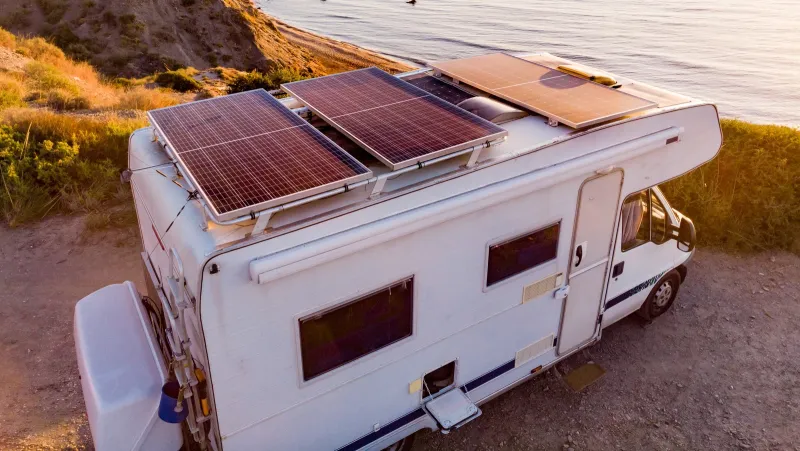
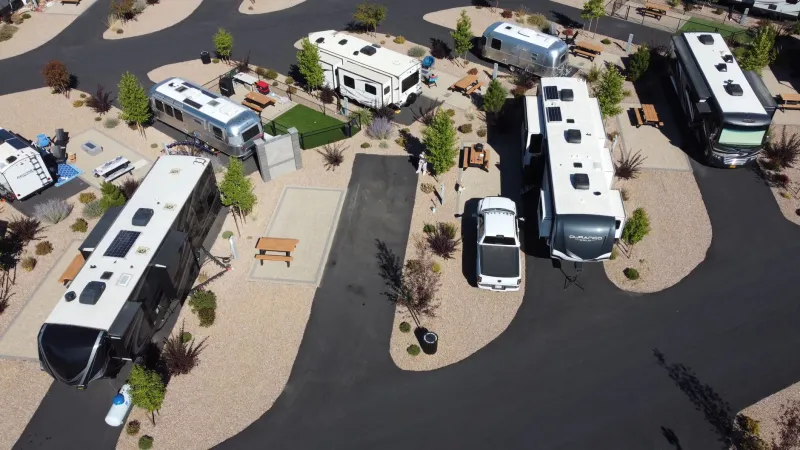
- RV and camper storage: The classic use case. Plug it into the trailer's solar port or alligator-clip it to the house battery and stop paying for electric storage sites just to keep batteries alive.
- Boats: Trolling motor and starting batteries take a beating over a season, then sit all winter.
- Farm and ranch equipment: Tractors, ATVs, and UTVs parked in open fields are exactly what these chargers were made for.
- Seasonal vehicles: Snowmobiles in summer, boats in winter, the classic car that only comes out on Sundays.
- Gates, cameras, and fencing: Any 12V device in a spot where running wire would be a nightmare.
A Few Honest Caveats
Solar chargers are fantastic at what they do, but know the limits:
- Cloudy weeks slow everything down. A maintenance charger will still keep up; a recovery charge takes longer.
- Panel placement matters. A panel flat on a dashboard behind tinted glass produces a fraction of its rated output. Outside, angled toward the sun, is always better.
- They won't fix a dead battery. If a battery is already sulfated or has a bad cell, no charger — solar or otherwise — is bringing it back.
- Winter sun is weaker. In northern states, expect roughly half the output of a July day. Size accordingly.
The Bottom Line
A 12V solar-powered battery charger is one of the rare pieces of gear that pays for itself the first time it saves you a jump start, a tow, or a replacement battery. It's the same philosophy behind every good off-grid setup — small, simple, and always quietly working while you're not thinking about it.
If you've got one battery that dies on you every season, start there. One 20-watt panel, one decent controller, and you're done buying batteries you didn't need to buy.