One Week, No Hookups: What a 400-Watt Rig Really Delivers in the Shaded Hollows of the Blue Ridge
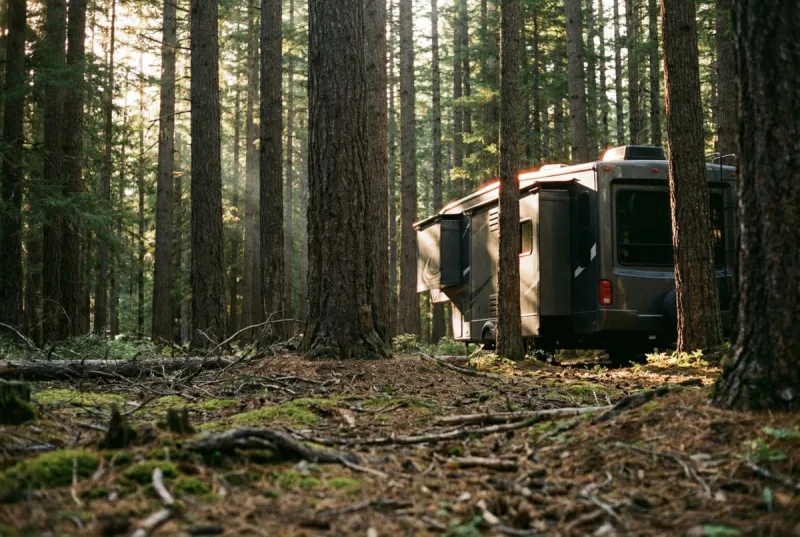
Photo: RV camper boondocking in forest clearing Blue Ridge Mountains morning fog, via rvboondocker.com
The Blue Ridge Parkway in early October is a boondocker's paradox. The dispersed camping along forest service roads near Asheville and the Pisgah National Forest is some of the prettiest free camping in America — and some of the hardest on a solar rig. Mature hardwood canopy covers most of it. Morning fog burns off late, if at all. And the humidity means you're running ventilation fans from dusk until well past dawn.
We drove in with a deliberately average setup: 400 watts of rooftop panels, a 30-amp MPPT controller, 200Ah of lithium, and the usual load profile of a working couple — laptops, a 12V fridge, LED lighting, two fans, and a water pump. No generator. No shore power. Seven nights.
Day One and Two: The Fog Tax
The first morning, we didn't see direct sun until 10:40. Our charge controller logged a peak input of just 38 watts during the fog hours — less than a tenth of our rated array. By the time the canopy thinned and the sun climbed, we were chasing a deficit.
That first full day netted us about 610 watt-hours of actual charge against a daily consumption of roughly 950. The math doesn't lie: we entered day two down 340Ah-worth of battery (at 12V, call it 28 amp-hours in the hole).
Here's the lesson that no manufacturer prints on the box: a 400W array in heavy shade behaves like a 100W array, and you need to budget accordingly.
Day Three: The Breakthrough We Almost Missed
On a hunch, we moved the rig into a clearing we'd passed on the way in — a 15-minute repositioning that felt like a hassle after two days of setting up camp. It wasn't. Our midday harvest jumped from 140 watts to just over 300. Same panels, same sun, same everything except the roof shadow of a single tulip poplar.
If you take one thing from this trip, take this: in the East, site selection is a solar decision. Out West, you park anywhere and harvest. Under Appalachian canopy, parking is power planning.
The Numbers, Honestly
Over the full week, here's what our rig actually delivered versus what the spec sheet promised:
- Average daily harvest: 740 watt-hours — about 46% of the array's theoretical clear-sky rating
- Best day: 1,180 watt-hours (full sun, clearing, fans off)
- Worst day: 380 watt-hours (fog and full canopy)
- Lowest battery voltage all week: 12.9V at 6 a.m. on day five — never in the danger zone
We never ran the fridge down, never skipped coffee, never sweated through a night without the fan. But we also never had the cushion a western boondocker takes for granted.
What We'd Change — and What We Wouldn't
Two modifications would have erased most of the stress. First, tilting the panels. Even a crude manual tilt toward the southern sky gained us measurable amps in the morning and evening shoulders. Second, a DC-DC charger off the truck's alternator would have turned our daily drives between overlooks into meaningful recharge windows — on day two, a 90-minute tow up the parkway could have replaced an entire day of fog.
What we wouldn't change is the array size. The temptation after a trip like this is to bolt on another 200 watts. But the honest accounting shows our problem wasn't capacity — it was placement. An extra panel on a shaded roof would have produced almost nothing extra.
The Verdict for Eastern Boondockers
If your dreams involve the national forests east of the Mississippi, plan your 12V system around your worst day, not your best. Size battery storage to survive two consecutive fog days, use every scrap of midday sun, and treat your parking spot like the biggest component in your system — because under that canopy, it is.
Freedom off the grid isn't just about how much power you can make. It's about knowing exactly how much you'll make before you ever turn into that forest service road.