Why Your RV's Solar Setup Goes Dead in December (And the Fixes That Actually Help)
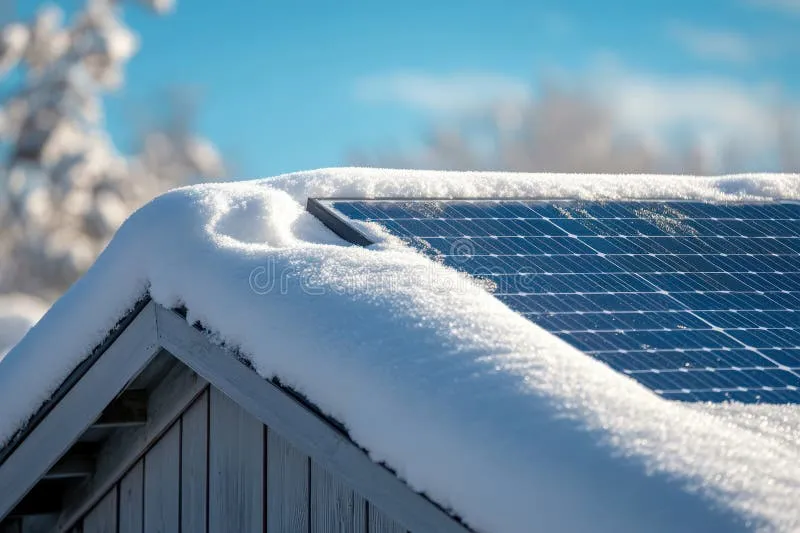
Photo: RV rooftop solar panels covered in snow winter campsite, via thumbs.dreamstime.com
The Rude Awakening That Hits Every First-Year Full-Timer
Talk to anyone who's lived in an RV full-time through their first winter, and you'll hear some version of the same story. The solar setup that powered everything effortlessly through July and August starts struggling in October. By December, they're rationing power, running the generator more than they ever planned, or — if they parked somewhere particularly overcast — watching their battery bank drain faster than their panels can recover it.
It's one of the most common frustrations in the RV solar community, and it's almost entirely preventable. But preventing it requires understanding what's actually happening — and that means letting go of a few assumptions that the solar industry doesn't always rush to correct.
The Myth of "Panels Still Work in Winter"
Technically, yes — solar panels still generate electricity in winter. That part is true. What often goes unsaid is how much less they generate, and why.
The two biggest winter culprits aren't temperature. They're daylight hours and sun angle.
In Phoenix, Arizona, you might average around 5–6 peak sun hours per day in July. By December, that drops to roughly 4–4.5. Annoying, but manageable. Now take that same RV to a campground outside Seattle, Washington in January. You're looking at 1–2 peak sun hours on a good day — and a lot of days that don't qualify as good. That's not a 20% reduction in output. That's potentially a 60–70% reduction.
Sun angle compounds the problem. In summer, the sun arcs high across the sky, hitting flat-mounted rooftop panels close to perpendicularly — which is the ideal angle for maximum output. In winter, the sun stays low on the horizon. That shallow angle means your panels are catching sunlight at a less efficient angle all day long, even on clear days. The effect varies by latitude, but if you're spending winter anywhere north of, say, the I-40 corridor, you're feeling it.
Cloud Cover Is the Silent Killer
Seasonal cloud cover is where a lot of RVers get blindsided. A partly cloudy day doesn't cut your solar output by 20–30%. Depending on cloud density and your panel type, you might see a 50–80% reduction in generation. A fully overcast day in the Pacific Northwest or Great Lakes region in January can drop output to nearly nothing for days at a time.
This is why battery bank sizing matters so much in winter. Your panels might generate enough on a sunny December day in New Mexico to top off your batteries. But if you're in Tennessee or Oregon, you need your battery storage to carry you through multi-day cloudy stretches — not just overnight.
Region-Specific Reality Check
Not all winters are created equal, and where you park makes an enormous difference. Here's a rough breakdown of what to expect across popular full-timer regions:
- Southwest (Arizona, New Mexico, Southern California): Winters are the sweet spot. Clear skies, mild temperatures, and 4–5 peak sun hours make solar performance nearly as reliable as summer. This is why so many full-timers migrate south — it's not just warmth, it's watts.
- Southeast (Florida, Georgia, Texas Gulf Coast): Shorter days than summer but generally workable. Expect 3–4.5 peak sun hours. Occasional cold fronts bring cloud cover, but extended overcast stretches are less common than further north.
- Mountain West (Colorado, Utah, Wyoming): A mixed bag. High altitude can actually improve panel efficiency (thinner atmosphere, less light diffusion), but snowfall creates its own problem — panels covered in snow generate exactly zero power.
- Pacific Northwest and Great Lakes: The toughest winter solar environments in the country. Persistent cloud cover, low sun angles, and limited daylight hours can make solar supplemental at best. If you winter here, plan accordingly.
The Snow Problem Nobody Mentions
Snow-covered panels are dead panels. It sounds obvious, but plenty of RVers are surprised to discover their rooftop array sitting under three inches of snow while their battery bank quietly drains. Unlike residential solar arrays that are often tilted steeply enough to shed snow naturally, most RV panels are mounted flat or at a shallow angle — which means snow sits and stays.
The fix is simple but requires actually doing it: clear your panels after snowfall. A soft-bristled roof brush or even a foam car-washing brush works well without scratching the glass. Some full-timers add a light tilt to their panels using adjustable mounts, which helps with both snow shedding and improving the winter sun angle.
Practical Fixes That Don't Require Buying a Whole New System
You don't necessarily need to double your panel array to survive winter. Here's what actually moves the needle:
1. Tilt your panels. Even a 15–20 degree tilt toward the south can meaningfully improve output during low-sun-angle winter months. Portable folding panels that you can prop up at the right angle are a surprisingly effective supplement for RVers who don't want to permanently modify their roof mounts.
2. Chase the sun. This sounds flip, but it's real strategy. If you have flexibility in where you park, orienting your RV so your roof panels face south — and choosing campsites with southern exposure rather than tree coverage — can recover a significant chunk of lost winter production.
3. Reduce your loads. Winter is a good time to audit what you're actually running. Swapping to LED lighting if you haven't already, using a 12V heated blanket instead of a propane heater fan, and being deliberate about device charging schedules can cut your daily consumption enough to close the gap.
4. Add a battery monitor. If you don't have one, get one. Knowing your actual state of charge in real time — rather than guessing based on a voltage reading — lets you make smarter decisions about when to conserve and when you have headroom to spare.
5. Consider a small supplemental charging source. A DC-to-DC charger that pulls from your tow vehicle or motorhome's alternator while you're driving gives your battery bank a boost on travel days. It's not a full solution, but it's a meaningful one.
The Honest Bottom Line
Winter solar isn't a death sentence for your off-grid setup — but it does require you to stop thinking about your 12V system the same way you do in July. Adjust your expectations by region, keep your panels clear, tilt them toward the sun when you can, and size your battery bank to cover the lean days. Do that, and you'll find that winter off-grid living is genuinely manageable — maybe even enjoyable — without a generator running every afternoon.