Why Your Off-Grid Tiny Home Solar System Hits a Wall Every Winter
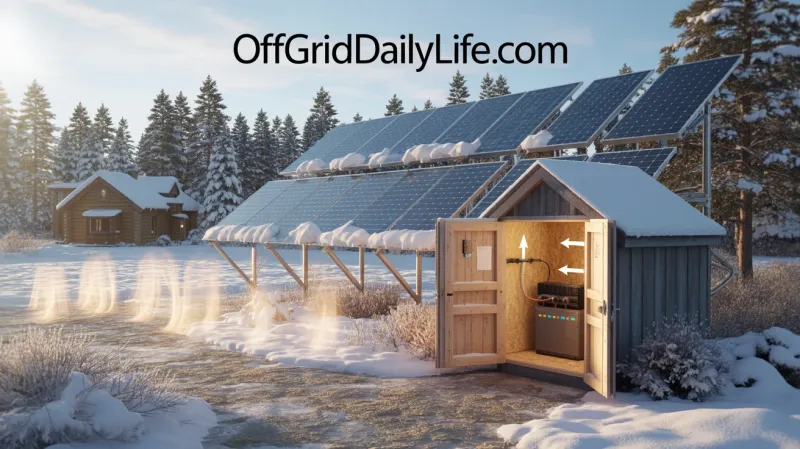
Photo: tiny house off-grid solar panels snow winter, via offgriddailylife.com
There's a particular kind of frustration that hits around the first week of December. Your tiny home's solar setup has been humming along beautifully since May. The batteries stay full, the lights are bright, the chest freezer runs without complaint. Then the days get short, the sun dips low in the sky, and suddenly your system is underperforming in ways that feel almost personal.
This isn't a fluke. It's physics—and it's something that RV-focused solar guides rarely address with the depth that permanent off-grid dwellers actually need. When your home doesn't move, you can't just reposition yourself toward better sun. You're locked into your latitude, your roof pitch, and whatever shade situation your property throws at you. That makes winter solar planning a genuinely different problem.
Latitude Changes Everything (And Most Calculators Ignore It)
The sun's angle above the horizon in December varies dramatically across the US. In Miami, Florida, the winter sun still reaches about 40 degrees above the horizon at midday—respectable. In Minneapolis, Minnesota, that same midday sun barely clears 25 degrees. In Anchorage, Alaska? You're looking at roughly 6 degrees on the winter solstice.
Why does this matter for your 12-volt system? Because solar panels are rated at a specific angle to the sun. The further the sun dips from perpendicular to your panels, the less energy they capture—and the effect isn't linear. A sun angle that's 30 degrees off optimal can cut your effective output by 25–40%, depending on conditions.
For a stationary tiny home, this means your fixed-tilt panels need to be angled much steeper in winter than in summer. The general rule of thumb is to set your panel tilt to your latitude plus 15 degrees for optimal winter performance. So if you're in Nashville (latitude ~36°), your winter-optimized tilt is around 51 degrees. That's steep. Most tiny home roofs don't come close to that.
Adjustable ground mounts or tilt-adjustable roof mounts let you change the angle seasonally. It's one of the most cost-effective upgrades a stationary off-grid system can make.
The Real Sun Hours Map for Year-Round Living
Peak sun hours—the metric that determines how much energy your panels actually produce on a given day—swing wildly by season and region. Here's a rough reality check for a few key US locations:
| Location | Summer Peak Sun Hours | Winter Peak Sun Hours |
|---|---|---|
| Phoenix, AZ | 7.5 | 5.5 |
| Denver, CO | 6.5 | 4.5 |
| Portland, OR | 5.5 | 2.0 |
| Minneapolis, MN | 5.0 | 3.0 |
| Burlington, VT | 4.5 | 2.5 |
Notice that Portland in winter gets less than half the usable sun of Phoenix in winter. If you sized your battery bank and panel array based on summer performance in a northern or Pacific Northwest climate, you designed yourself into a corner.
For year-round off-grid habitation, size your system to your worst month, not your average. That usually means winter in most of the continental US.
Cold Weather and Your Battery Bank: The Chemistry Problem
Lead-acid batteries—including AGM and gel variants—lose meaningful capacity in cold temperatures. A battery bank rated at 200Ah at 77°F might only deliver 140–160Ah at 32°F. Push it below freezing consistently and you're looking at even steeper losses.
Lithium iron phosphate batteries handle cold better in terms of discharge, but they have their own quirk: most LiFePO4 batteries cannot safely accept a charge when the cells are below freezing. Charging a cold lithium battery can cause permanent internal damage. Quality lithium batteries include a built-in low-temperature cutoff that prevents charging until the cells warm up—but budget cells often skip this protection.
For tiny homes in cold climates, battery placement matters enormously. Keeping your battery bank inside a conditioned or semi-conditioned space—even a well-insulated cabinet that captures some ambient heat from your living space—can make a significant difference in both capacity and charge acceptance.
Weatherproofing Your System for Stationary Use
RV solar systems are designed to be somewhat portable and relatively easy to service. Permanent tiny home installations face a different set of environmental stressors: prolonged snow loading, freeze-thaw cycles that work on sealants and conduit fittings, and years of UV exposure rather than months.
A few things that matter more for stationary systems than mobile ones:
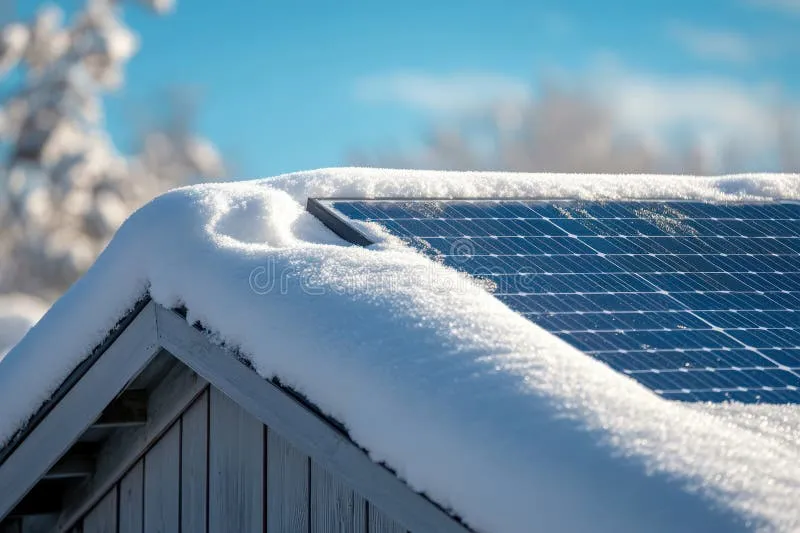
Snow load and panel angle. Steeply angled panels shed snow naturally. Flat or low-angle panels accumulate snow and can go dark for days during heavy winter weather. This is another argument for steep winter tilt angles—they're also self-cleaning.
Conduit and outdoor wiring. Outdoor-rated conduit (schedule 80 PVC or liquid-tight flexible conduit) protects your wiring runs from UV degradation and physical damage over years of exposure. This is code-required in many jurisdictions even for off-grid installations.
Charge controller placement. MPPT controllers generate heat and don't love temperature extremes. Mount yours in a location with stable temperatures—inside your living space is often best. An insulated utility closet works well.
Recalculating Your Battery Size for Winter Reality
Here's a simple framework for recalculating whether your battery bank is actually sized for year-round use:
- Determine your daily amp-hour consumption (from a thorough load audit).
- Look up your location's December peak sun hours from a resource like the NREL PVWatts calculator.
- Calculate how many amp-hours your panel array produces on an average December day.
- The gap between consumption and production is what your battery bank needs to cover—ideally across 2–3 days of low production.
For example: if you consume 80Ah per day and your panels produce 40Ah on a typical December day in Vermont, you need your battery bank to cover 40Ah of shortfall per day. Across a 3-day cloudy stretch, that's 120Ah of usable reserve—before accounting for battery chemistry losses in the cold.
For a lead-acid system in a cold climate, that means your rated capacity needs to be significantly higher than your usable reserve target. For lithium, the math is tighter but the low-temperature charging concern still applies.
The Bottom Line for Year-Round Off-Grid Life
Building a 12-volt solar system for a tiny home that performs well in all four seasons requires a fundamentally different mindset than a fair-weather setup. You're not designing for the best case—you're designing for January in your specific ZIP code.
That means steeper panel angles, more battery capacity than summer math suggests, attention to where and how your batteries are stored, and a realistic understanding of what your local winter sun can actually deliver. It's more planning upfront, but it's the difference between a system that powers your freedom year-round and one that leaves you cold and dim every winter solstice.
The grid is always there as a fallback. The whole point of going off-grid is making sure you don't need it.